As Product Design Manager and Design & Research Lead, I spearheaded an 4-month initiative to redesign our conversational AI platform, consolidating three disconnected products — Agent Assist (voice), Chat/WhatsApp support, and Email self-service — into a unified, LLM-powered agent experience.
Our contact center solution suffered from critical fragmentation. Three separate products — each with distinct configuration systems — created operational inefficiencies and poor user experiences.
Product Ecosystem Issues
| Agent Assist | Used intent-based NLP detection |
| Chat Support | Relied on keyword-based systems |
| Email Self-Service | Operated independently |
| Cross-Product | No communication or data sharing between products |
| Configuration | Inconsistent design-time configuration across platforms |
| Runtime | Limited capabilities (only Agent Assist and Chat had active assistance) |
Critical UX Problems Identified
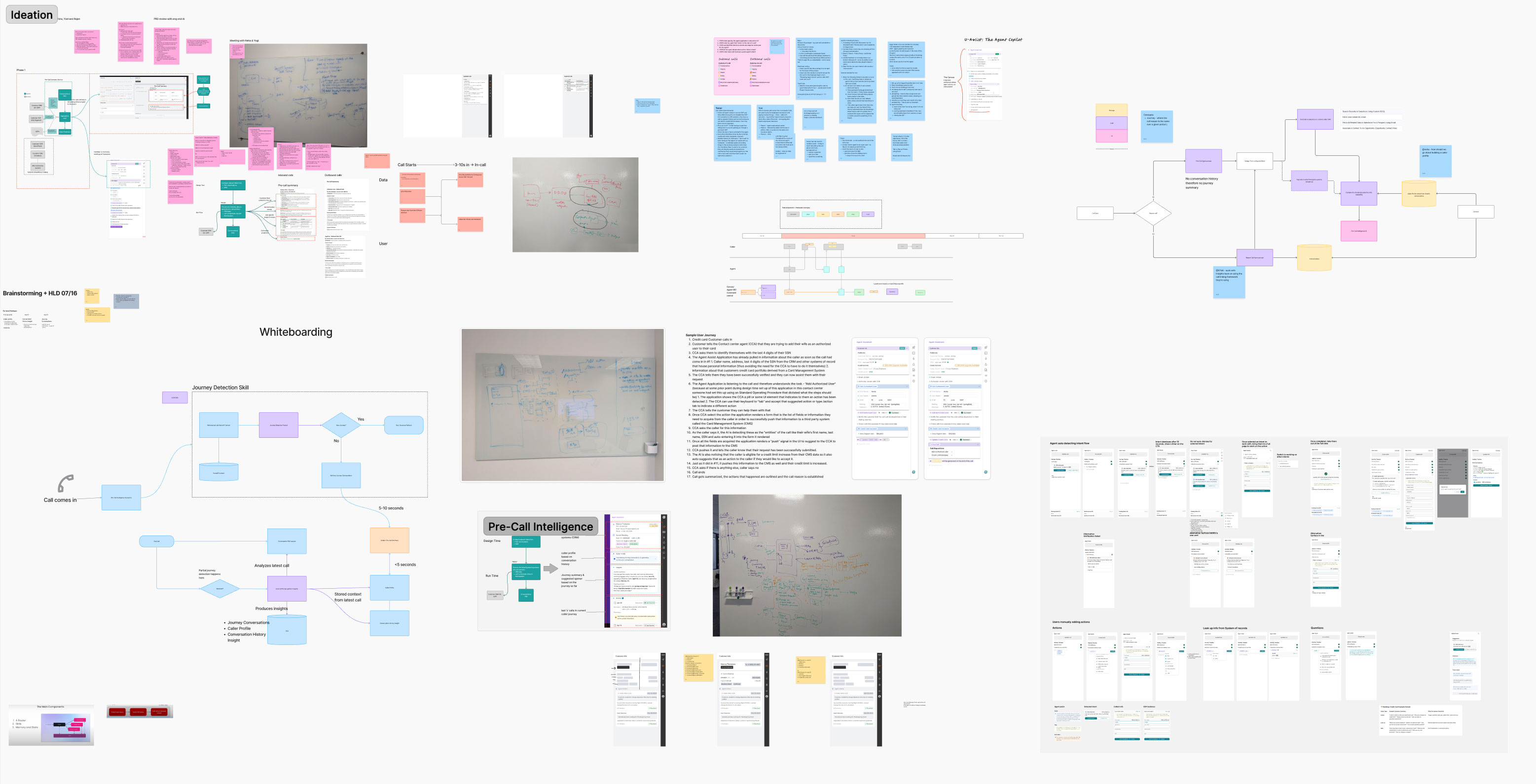
As Design & Research Lead, I architected a comprehensive discovery phase combining multiple research methodologies to build a complete picture of user needs and market opportunities.
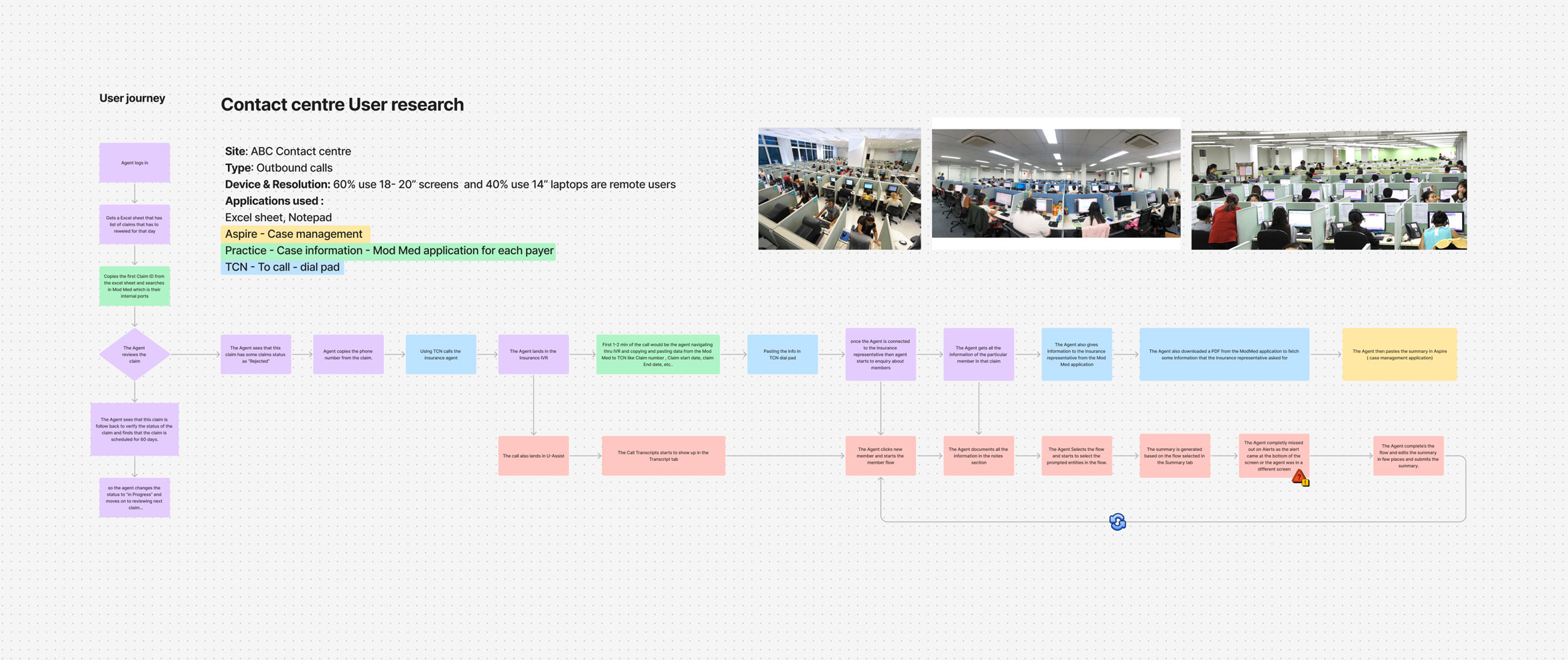
Field Research Approach
| Methods | Contextual inquiries with call center agents, shadowing during live calls |
| Mapping | End-to-end journeys for different call types, environmental factors |
| Key Insights | Agents processed information non-linearly. Legacy CRM forced rigid workflows. Alert fatigue from poorly timed notifications. High cognitive load from managing multiple mental models. |
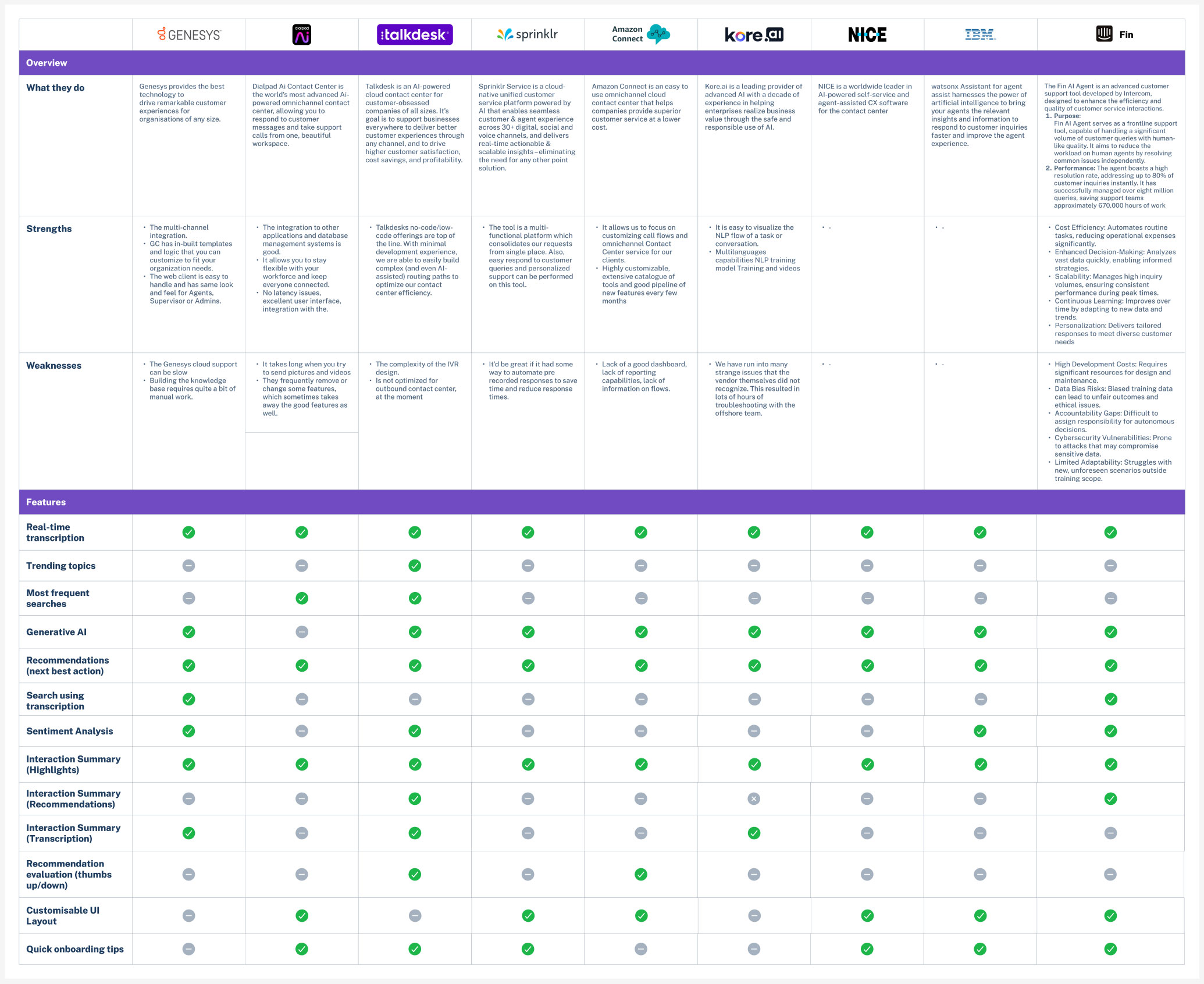
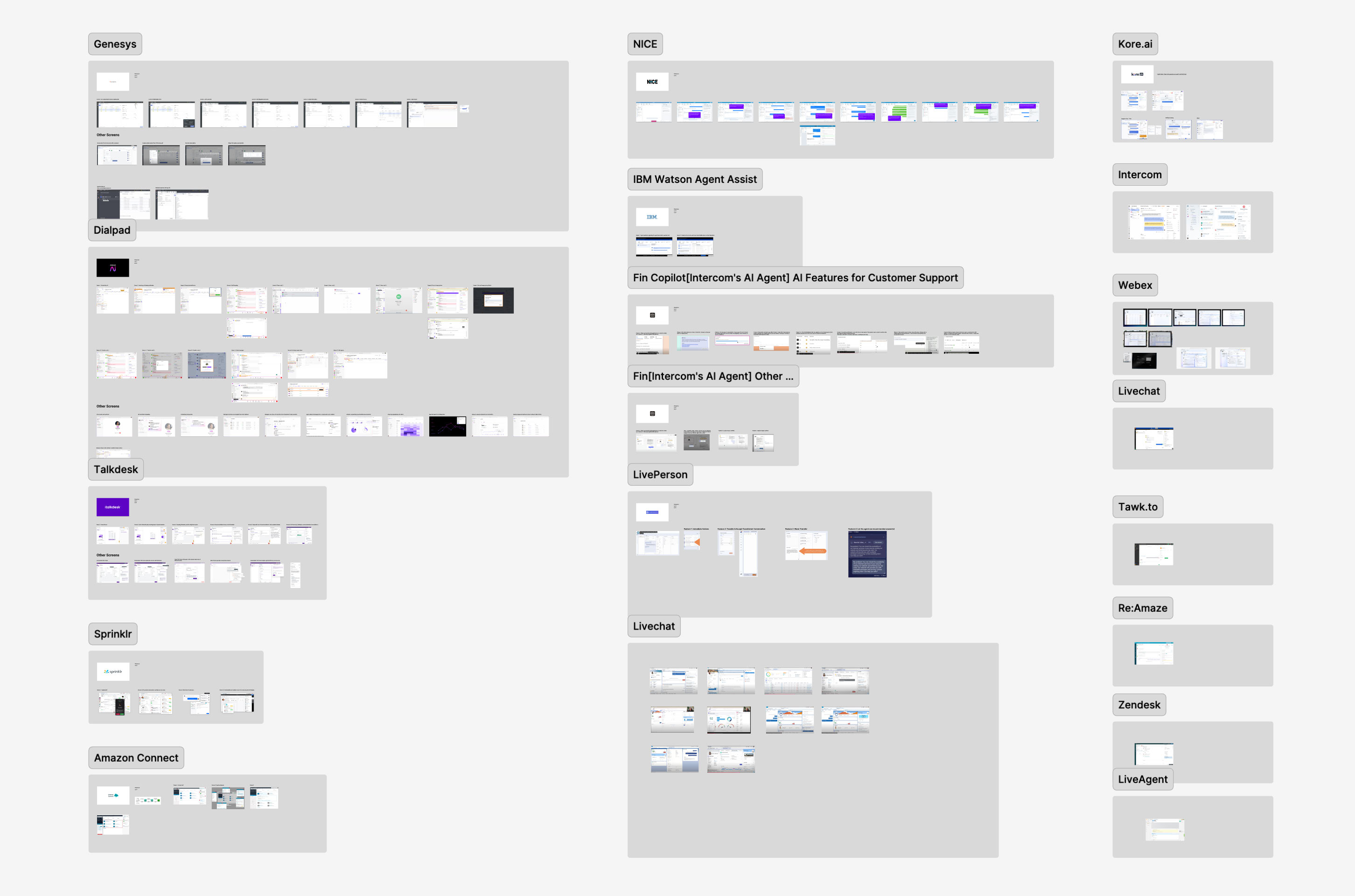
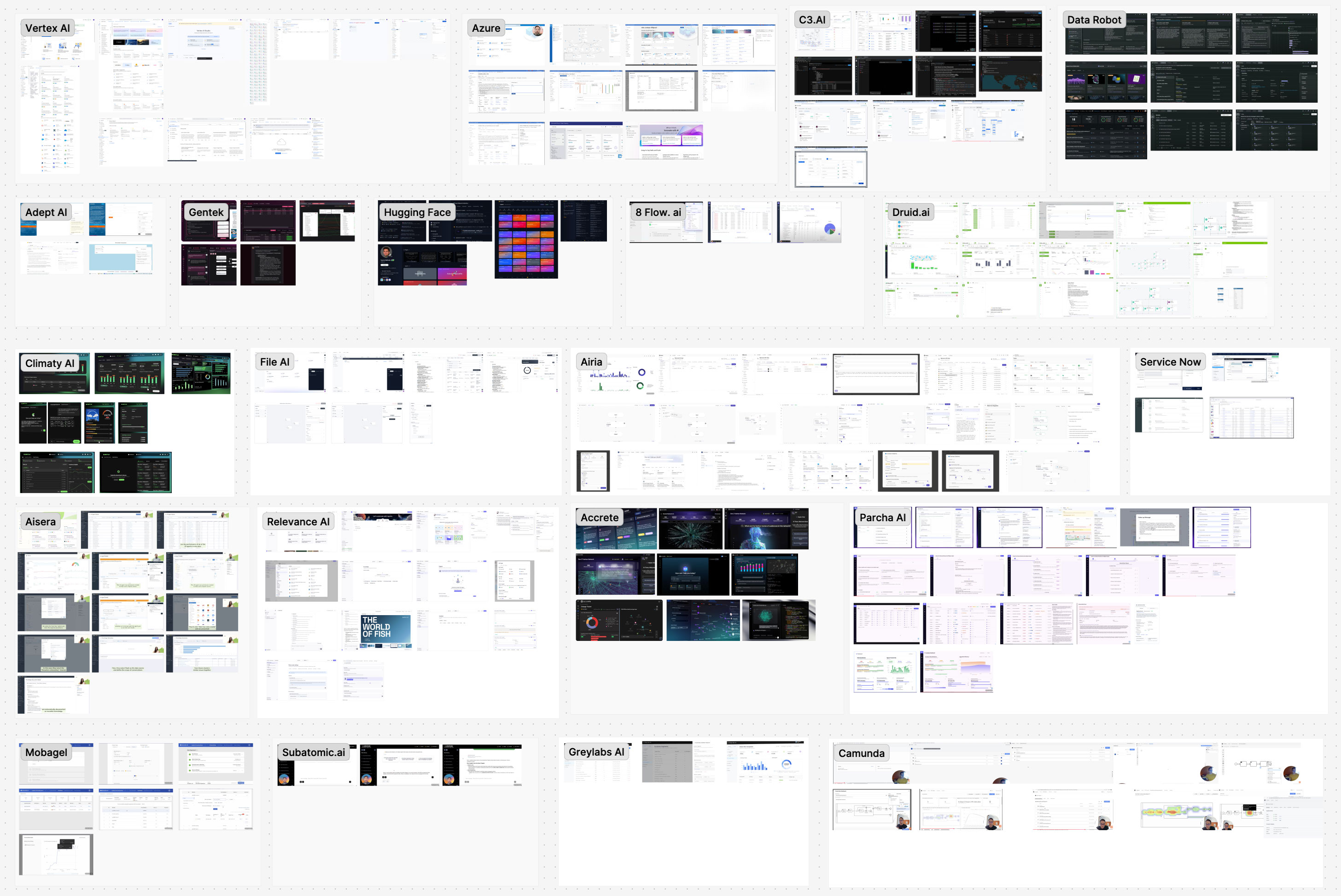
I analyzed 10-15 competitors to understand market positioning and identify feature gaps.
Key Insights:
Leveraged Strella AI for advanced user research and feedback analysis with quantitative rigor.
Methodology:
Critical Findings from Strella AI Research
| Real-time Data Sync | Agents required conversation RAG (Retrieval-Augmented Generation) updates at call completion, not the current 4-hour delay. This directly impacted our technical architecture decisions. |
| Resolution Tracking | Surfacing resolution status and related case numbers as prominent entities proved essential for agent efficiency. |
| Info Architecture | Historic conversations needed restructuring with a mini-timeline view for better readability and accessibility, rather than dense text blocks. |
| Caller Profile | This label didn’t resonate with users. Agents needed journey-specific context or caller communication preferences (e.g., “speaks slowly, requires repetition”) rather than generic profile data. |
| Contextual Integration | Opening scripts felt disconnected. Agents wanted integrated, contextual information rather than separate information blocks requiring cognitive assembly. |
| Visual Hierarchy | Color usage in high-stress contact center environments demanded exceptional care — it drove attention more powerfully than in typical applications. |
| Interaction Efficiency | Expanding/collapsing call history needed smoother, more accessible controls for rapid information access during live calls. |
| Entity Recognition | Opportunity to use LLM capability to extract case IDs generated during calls and use them as journey identifiers, reducing manual data entry. |
With research insights in hand, I led my team through an intensive ideation and prototyping phase, emphasizing quantity over initial quality to explore the full solution space.
Exploration Philosophy
Rather than converging prematurely on a single approach, we deliberately explored multiple directions:
Key Design Pivots
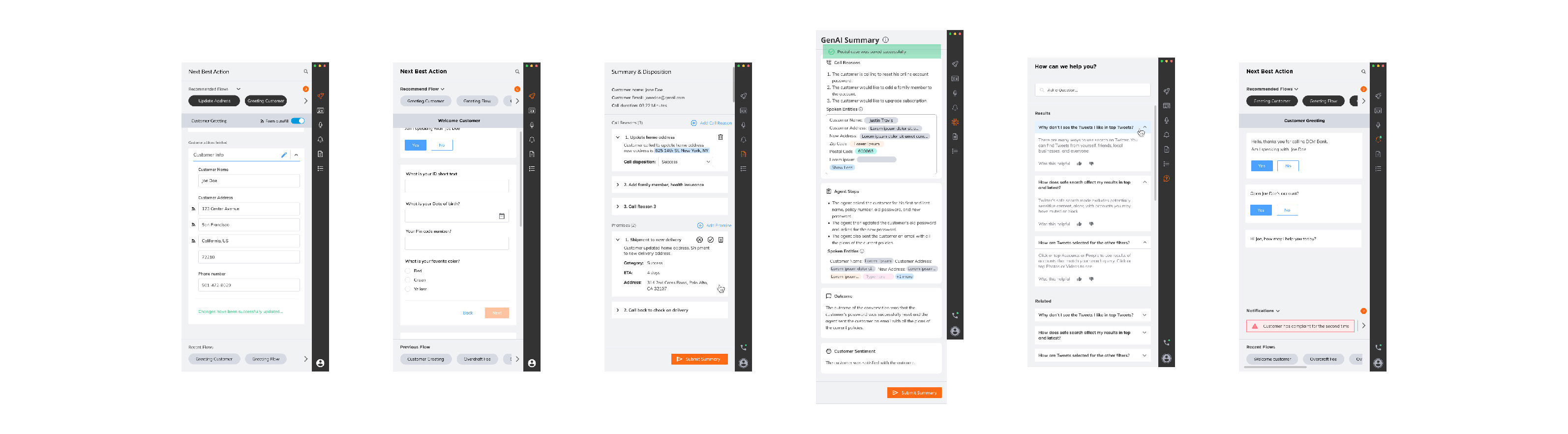
1. Abandoning the 70-30 Split. Research revealed agents actually preferred full-screen tab switching over split views. The 70-30 ratio prevented focus during calls and didn’t accommodate non-responsive legacy systems. We redesigned around tab-based navigation with intelligent context preservation.
2. Alert Visibility Redesign. Instead of hiding alerts in tabs, we introduced a persistent alert panel with visual hierarchy, context-aware alert prioritization, mandatory acknowledgment patterns for critical notifications, and smart alert dismiss interaction that required agent confirmation. This resulted in 100% alert visibility and zero missed critical notifications post-launch.
3. Contextual Information Architecture. Rather than forcing agents to hunt for information across tabs, we surfaced relevant information based on call context, introduced collapsible sections with intelligent defaults, designed a mini-timeline for customer journey visualization, and integrated opening context directly into the main call interface.
Final Design Solution
The redesigned Agent Assist interface transformed the agent experience through strategic information architecture, intelligent assistance, and seamless workflow integration.
Impact & Outcomes
Qualitative Improvements
Business Impact
While redesigning the agent-facing experience, we recognized a fundamental opportunity to transform our backend architecture. The emergence of Large Language Models presented a chance to eliminate the complexity of managing separate intent-based and keyword-based systems. This wasn’t just a technical migration — it was a fundamental rethinking of how we build, configure, and deploy conversational AI solutions.
Design Challenge: Unified Configuration Experience
Creating the Unified Agent Studio meant solving a complex design problem: how do we give non-technical users the power to create, configure, and orchestrate multiple AI agents without requiring engineering expertise?
Key Design Requirements
| 01 | Single configuration interface for all channels (voice, chat, email, WhatsApp) |
| 02 | Visual flow builder for agent orchestration |
| 03 | Knowledge base integration and management |
| 04 | Multi-agent coordination and handoff design |
| 05 | Testing and simulation capabilities |
| 06 | Version control and deployment management |
Research: Flow Builder Competitive Analysis
As Design Lead, I conducted extensive research into flow builder interfaces across the market. We analyzed 10-15+ competitors to understand successful patterns and identify opportunities for innovation.
Competitors Analyzed
| Enterprise Automation | Salesforce Flow, Microsoft Power Automate |
| Conversational AI | Dialogflow, Amazon Lex, Rasa |
| No-code / Low-code | Zapier, Make, n8n |
| Workflow Orchestration | Airflow, Prefect |
Key Research Insights: Node-based interfaces provided the best balance of power and usability. Contextual property panels reduced cognitive load. Inline validation prevented downstream errors. Visual feedback during flow execution aided debugging. Template libraries accelerated common use cases.
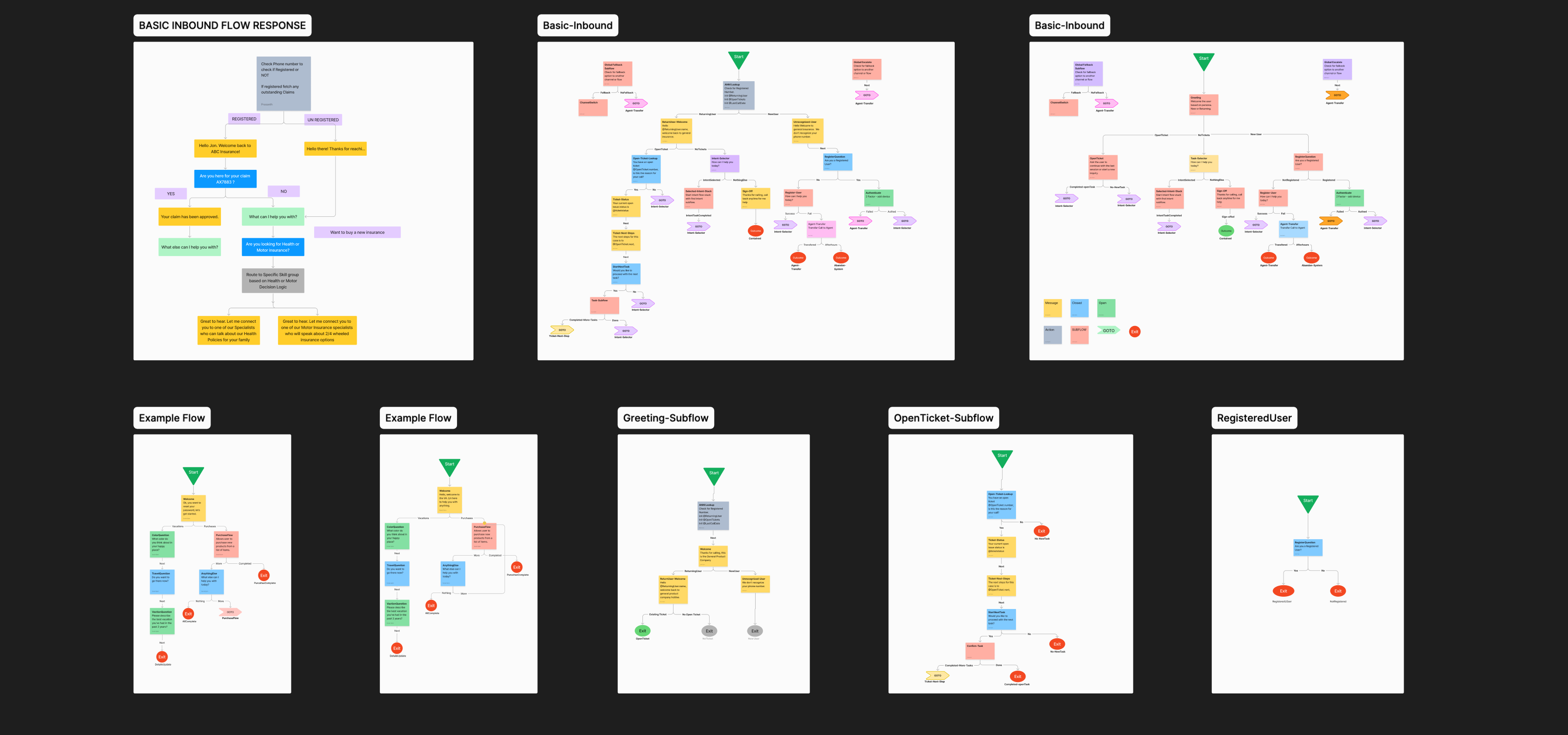
Design Exploration: Flow Builder Iterations
Understanding that the flow builder would be the heart of the Unified Agent Studio, I led multiple rounds of exploration to find the optimal balance between simplicity and power.
Approaches Explored
| Linear Timeline | Good for simple flows, broke down with complexity |
| Swimlane Model | Excellent for showing parallel processes, but steep learning curve |
| Node-based Graph | Best balance of flexibility and comprehension |
| Decision Tree | Clear logic flow, limited for non-linear conversations |
| State Machine | Powerful but too technical for target users |
We ultimately converged on a hybrid node-based approach that combined the intuitiveness of visual flows with the power of state management.
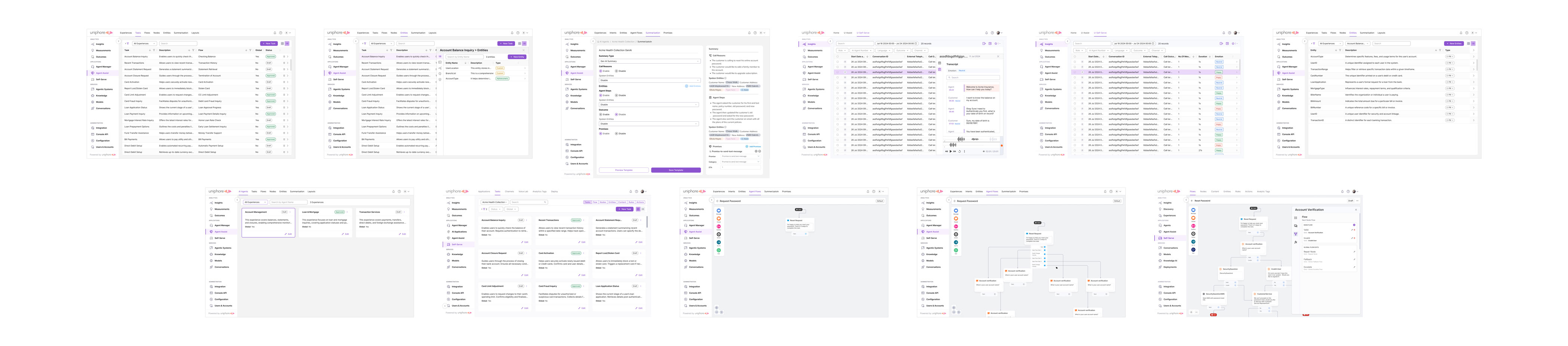
Final Solution: Core Capabilities
The Unified Agent Studio provides a comprehensive design-time environment for creating, configuring, and managing AI agents across all channels.
Flow Builder Key Differentiators
| Context Preservation | Visual indicators show data flow between nodes |
| Agent Specialization | Clear distinction between single-agent and multi-agent nodes |
| Inline Validation | Real-time error detection and suggestions |
| Collaborative Editing | Multi-user support with conflict resolution |
Technical Innovation: LLM-Powered Intent Detection
The shift from manual intent configuration to LLM-powered detection represented a fundamental change in how our system understands and responds to user needs.
Design Implications: This architectural shift allowed us to simplify configuration interfaces, reduce time-to-deployment from weeks to days, enable non-technical users to create sophisticated agents, support more natural and flexible conversations, and eliminate manual intent maintenance.
Design System Integration
As our team included a dedicated design system designer, we ensured consistency and scalability across the entire Unified Agent Studio.
This systematic approach accelerated development velocity and ensured quality across the expanding product surface area.
Team Structure & Allocation
As Product Design Manager, I structured a lean, high-performing team of 4:
| 2 Product Designers | Focused on Agent Assist interface and Unified Agent Studio flows |
| 1 Design System Designer | Maintained consistency and built reusable components |
| Myself (Design Manager) | UX Research, Design Strategy, Stakeholder Management, and hands-on design leadership |
Building on the success of the Agent Assist redesign and Unified Agent Studio launch, we’ve mapped a clear path forward for continued innovation and value delivery.
Objective: Empower agents with comprehensive context before calls begin
Key Initiatives:
Design Focus:
Objective: Evolve Task Guide from reactive suggestions to proactive coaching
Key Initiatives:
Design Focus:
Strategic Priorities
| Timeline | Initiatives |
|---|---|
| Near-term (6 months) | Iterate on Unified Agent Studio based on early adopter feedback. Expand KaaS capabilities with multi-modal knowledge sources. Enhance flow builder with advanced debugging tools. Build template library for common use cases. |
| Long-term (12-18 months) | AI-powered flow optimization suggestions. Autonomous agent creation from business requirements. Multi-language and localization support. Advanced analytics and insight generation. |
This 4-month journey from fragmented products to unified, AI-powered experience taught valuable lessons about design leadership in enterprise AI:
Conclusion
The Unified Agent Studio project demonstrates how strategic design leadership can transform enterprise AI products. By combining deep user research, systematic competitive analysis, and bold architectural vision, we created a platform that not only solved immediate user pain points but positioned the company for the future of agentic AI.
The measurable impact — 46% reduction in handling time, 38% improvement in satisfaction, 68% increase in self-service resolution — validates the power of human-centered design in complex enterprise systems. More importantly, we created a foundation for continuous innovation that will serve customers and agents for years to come.
This case study represents not just a successful product redesign, but a model for how design leadership can drive business transformation in the age of AI.
| Duration | 4 months |
| Role | Product Design Manager, Design & Research Lead |
| Team | 4 designers (2 Product Designers, 1 Design System Designer, 1 Design Manager) |
| Methodologies | Field research, competitive analysis, user journey mapping, Strella AI validation, iterative prototyping |
| Technologies | LLM-powered multi-agent architecture, KaaS vector databases, real-time conversation RAG |